


How to Solve Sudoku for Beginners Step by Step
Learn the basic rules, where to start and how to solve your first puzzles without guessing.
How to Solve Sudoku for Beginners Step by Step
If you want to learn how to solve sudoku for beginners, the first thing to understand is that no mathematics are involved. You don’t add, subtract, or calculate anything. The whole game runs on a single logical rule, and once you see it clearly, every puzzle becomes much more approachable. You sit down with a fresh sudoku, pencil in hand, and what looks like an intimidating grid of empty cells starts to make sense. Most people at that moment do one of two things: guess, or give up. Neither works, and neither has to happen to you.
At Lolita Perrins Books, we design sudoku books for people who want to enjoy the puzzle without getting stuck on the first page. And we’ve seen where most beginners get lost: it is almost never the puzzle itself, but the absence of a clear starting method. This step-by-step sudoku guide gives you that method: the basic rules, simple solving techniques, visual examples and the most common mistakes to avoid. By the end, you’ll know where to look, what to check and what to do next.
The one rule that governs every sudoku grid
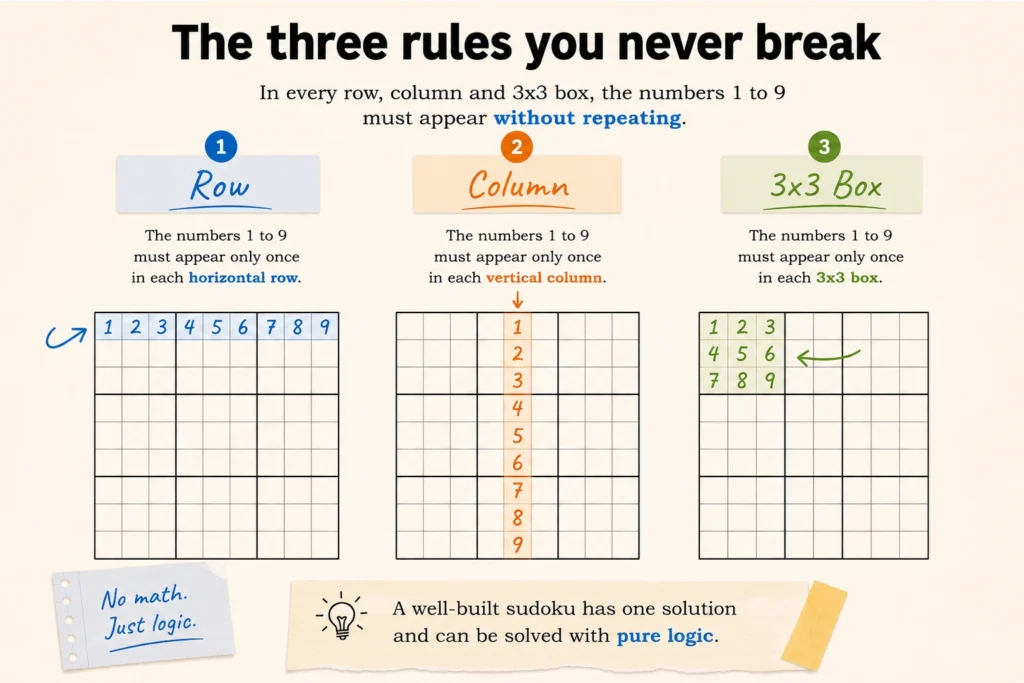
Before you use any solving technique, you need to understand the anatomy of the puzzle. A standard 9×9 sudoku grid has nine horizontal rows, nine vertical columns, and nine smaller 3×3 boxes. Every empty cell belongs to these three areas at the same time: one row, one column, and one box.
That is why every move in sudoku starts with the same check: look at the row, look at the column, and look at the 3×3 box.
The three areas you always need to check
Every row, every column, and every 3×3 box must contain the digits 1 through 9, each exactly once. No digit can repeat inside its row, its column, or its box. That is the whole logic of sudoku.
There are no calculations involved. The number 5 does not mean “five things”; it is simply one of nine different marks that must be placed correctly. You could play with letters or colors and the logic would be the same.
Why guessing is never the answer
A well-built sudoku has one solution and can be solved through logic. When you guess, you may place a digit that looks possible but breaks a rule somewhere else in the grid. The problem is that the mistake may not appear immediately. It can stay hidden for several moves, and by the time you notice it, fixing the puzzle is often harder than starting again.
If you cannot explain why a number goes in a cell, do not write it yet. Check another row, column or box and keep looking.
How to solve sudoku for beginners: where to start scanning
Most beginners freeze because they do not know where to look first. The answer is scanning: moving your eyes across rows, columns and 3×3 boxes before writing anything down. Start with the areas that already have the most filled-in numbers. A nearly complete row, column or box gives you fewer possibilities and a much easier first move.
This first scan is not wasted time. It is how you learn to read the grid before trying to solve it.
Finding nearly complete rows, columns and boxes
When a row already shows eight of its nine digits, the missing one is the answer. If a row contains 1, 2, 3, 4, 6, 7, 8 and 9, the only missing digit is 5. Place it immediately.
The same logic works with columns and 3×3 boxes. The more numbers an area already has, the fewer options remain.
Basic elimination: rule out before you write
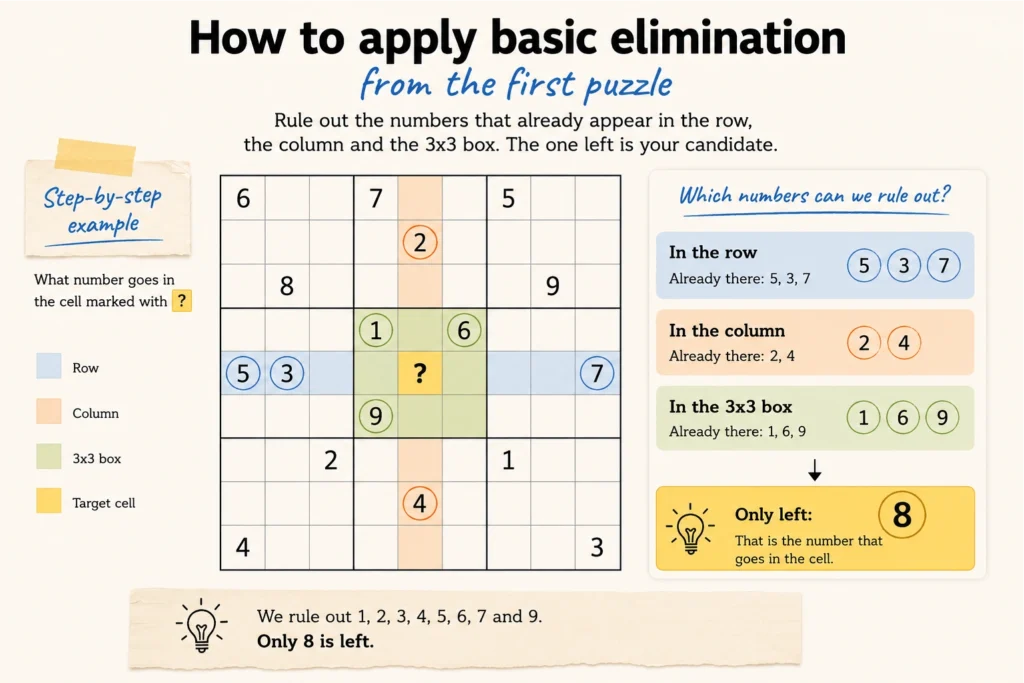
Once you find an empty cell in a promising area, check its row, its column and its 3×3 box. Any number that already appears in one of those three areas cannot go in that cell.
For example, imagine an empty cell marked with a question mark. Its row already contains 5, 3 and 7. Its column already contains 2 and 4. Its 3×3 box already contains 1, 6 and 9. If you rule out all those numbers, only one option remains: 8. That cell must be 8.
Cross-referencing boxes to narrow down placement
Scanning across related boxes can also reveal where a number must go. If the digit 7 already appears in two boxes in the same band of the grid, the third box may have only one possible row left for that 7. You may not know the exact cell immediately, but you have narrowed the puzzle down. Combine that with column checks, and the placement often becomes clear.
Two beginner sudoku techniques that keep the puzzle moving
Once the obvious cells are filled through scanning and basic elimination, you need two reliable tools to keep moving: naked singles and hidden singles. They are simple, logical and useful in almost every easy sudoku puzzle.
Each technique looks at the grid from a different angle. A naked single asks what can go in one cell. A hidden single asks where one specific number can go.
Naked singles: when only one number fits a cell
A naked single happens when, after checking a cell’s row, column and 3×3 box, only one digit remains as a possibility.
Here is a simple example. A cell’s row already contains 1, 2, 3 and 4. Its column adds 6 and 8. Its box adds 7 and 9. That accounts for eight of the nine digits. Only 5 is left. So the cell must be 5.
It is called a naked single because the answer is not hidden behind other options. Once you check the row, column and box, there is only one possible number left.
Hidden singles: when only one cell fits a number
A hidden single works from the opposite direction. Instead of asking “what can go in this cell?”, you ask “where can this number go?”
Look at the digit 4 within a row. If every empty cell except one is blocked because of the numbers already placed in its column or 3×3 box, then the remaining cell must take the 4. That can be true even if the cell still seems to have other candidates at first glance.
The answer is “hidden” because you do not find it by looking at the cell alone. You find it by checking where a specific number can still fit inside a row, column or box.
How these two techniques work together
One placed number changes the rest of the grid. It removes candidates from nearby cells, creates new naked singles and can reveal hidden singles that were not visible a moment before.
That is why sudoku starts to feel easier once you stop looking for random numbers and begin checking the grid in a fixed order: row, column, box, candidates, next move.
Using pencil marks when the obvious cells are gone
After scanning and applying singles, you will eventually reach a point where no placement feels obvious. This is normal. That is when pencil marks become useful.
Pencil marks, also called candidates, are small digits written inside an empty cell to record every number that could still go there. They are not guesses. They are organized information.
What pencil marks are and how to write them
Take an empty cell. Check its row, column and 3×3 box. Then list every digit from 1 to 9 that does not already appear in those three areas.
If a cell could hold 3, 5 or 8, write those numbers small inside the cell. Keep them neat and easy to erase, because they will change as the puzzle progresses.
You do not need to fill every empty cell with candidates from the first minute. For easy sudoku puzzles, scanning and singles may carry you quite far. But when you stop seeing clear moves, pencil marks help you keep track without trying to remember everything in your head.
Eliminating candidates to find new singles
As more cells get filled, pencil marks start to narrow down. If you place a 3 in a column, every other cell in that column can no longer use 3 as a candidate.
This simple update can turn a cell with several possibilities into a naked single. A cell that used to have 3, 5 and 8 may become just 5 after the 3 and the 8 are eliminated. Once only one candidate remains, you have your next move.
Spotting naked pairs to eliminate further
Naked pairs are a small step beyond the basics, but they are useful once you are comfortable with candidates.
If two cells in the same row, column or 3×3 box share exactly the same two candidates, those two numbers are locked into those two cells. For example, if two cells in the same row can only be 4 or 5, then 4 and 5 cannot go anywhere else in that row.
You may not know yet which cell is 4 and which one is 5. But you can remove 4 and 5 from the other candidates in that row, column or box. That often reveals a new single and gets the puzzle moving again.
The mistakes that trap every beginner
Knowing the techniques is half the job. Avoiding common mistakes is the other half. Most beginners do not get stuck because sudoku is impossible. They get stuck because they skip one of the basic checks, try to remember too many candidates in their head, or place a number before they can justify it.
Guessing instead of reasoning
When you get stuck, it is tempting to place a number just to see what happens. That is usually the fastest way to break the puzzle. A wrong guess can stay hidden for several moves, and by the time you notice the contradiction, it may be hard to know where the mistake started.
If you cannot explain why a number goes in a cell, do not write it yet. Move to another row, column or box and keep looking.
Skipping boxes and only checking rows and columns
Most beginners scan rows and columns instinctively but forget the 3×3 boxes. The box rule is just as important, and it often reveals a placement that rows and columns missed.
Build the habit of checking all three areas before committing any digit: row, column, box.
Not using pencil marks early enough
Beginners often wait too long to start writing candidates, trying to hold all the possibilities in their head. This quickly becomes confusing.
When scanning and singles stop giving you clear moves, start using pencil marks. They help you see the options instead of trying to remember them.
Placing a number without checking all three rules
Placing a digit after checking only one or two areas is one of the easiest ways to create a mistake. Before writing a number, verify that it does not already appear in its row, its column or its 3×3 box.
Three checks, every time. This simple habit prevents most beginner errors before they happen.
How to build real skill through smart daily practice
Reading about techniques gives you the framework. Sitting down with actual puzzles builds the skill. The key is practising at the right difficulty level and choosing puzzles that let you apply what you have just learned.
Start with easy puzzles and resist jumping ahead
Easy sudoku puzzles are not beneath you. They help you build the pattern recognition that makes naked singles, hidden singles and pencil marks feel more natural over time.
Jumping too quickly into medium or hard puzzles usually creates frustration, not progress. Stay with easy puzzles until you can solve them with a clear method: scan the grid, check the row, column and 3×3 box, use candidates when needed, and avoid guessing.
What a good daily solving routine looks like
You do not need long sessions to improve. A short, focused puzzle session is often more useful than solving for a long time once in a while.
Start with one or two easy puzzles and pay attention to how you solve them. Do not time yourself to race. Use the clock only as a way to notice whether the same type of puzzle starts to feel more familiar after several sessions.
The goal is not speed. The goal is to build a habit: look carefully, reason each placement and learn to trust the process.
Where to find beginner-friendly puzzles to practise what you have learned
If you are ready to put all of this into practice, Lolita Perrins Books offers a free downloadable booklet of 360 sudokus. It is a simple way to start solving on paper, try different levels and practise the techniques from this guide without needing an app or a screen.
You can download the free booklet from Lolita Perrins and use it as a first practice companion: start with the easiest puzzles, write candidates when you need them and move up only when the grid starts to feel clear.
Your next step: solve one puzzle
You now have the basic foundation: the rule behind every grid, a scanning method to find your first placements, naked singles and hidden singles, pencil marks for trickier cells, and a few habits that help you avoid the most common beginner mistakes.
That is enough to start solving real puzzles. You do not need to memorize everything before you begin. Open an easy sudoku, check the row, the column and the 3×3 box, and make each placement only when you can explain why it belongs there.
If you want to practise on paper, download the free sudoku booklet from Lolita Perrins Books and start with the first easy puzzles. Learning how to solve sudoku for beginners is not about speed. It is about seeing the logic of the grid one move at a time.
We’d love for you to get to know us.
That’s why we’ve prepared a free printable pack of mandalas and puzzles, made especially for you. And yes — completely free.
Get my free puzzles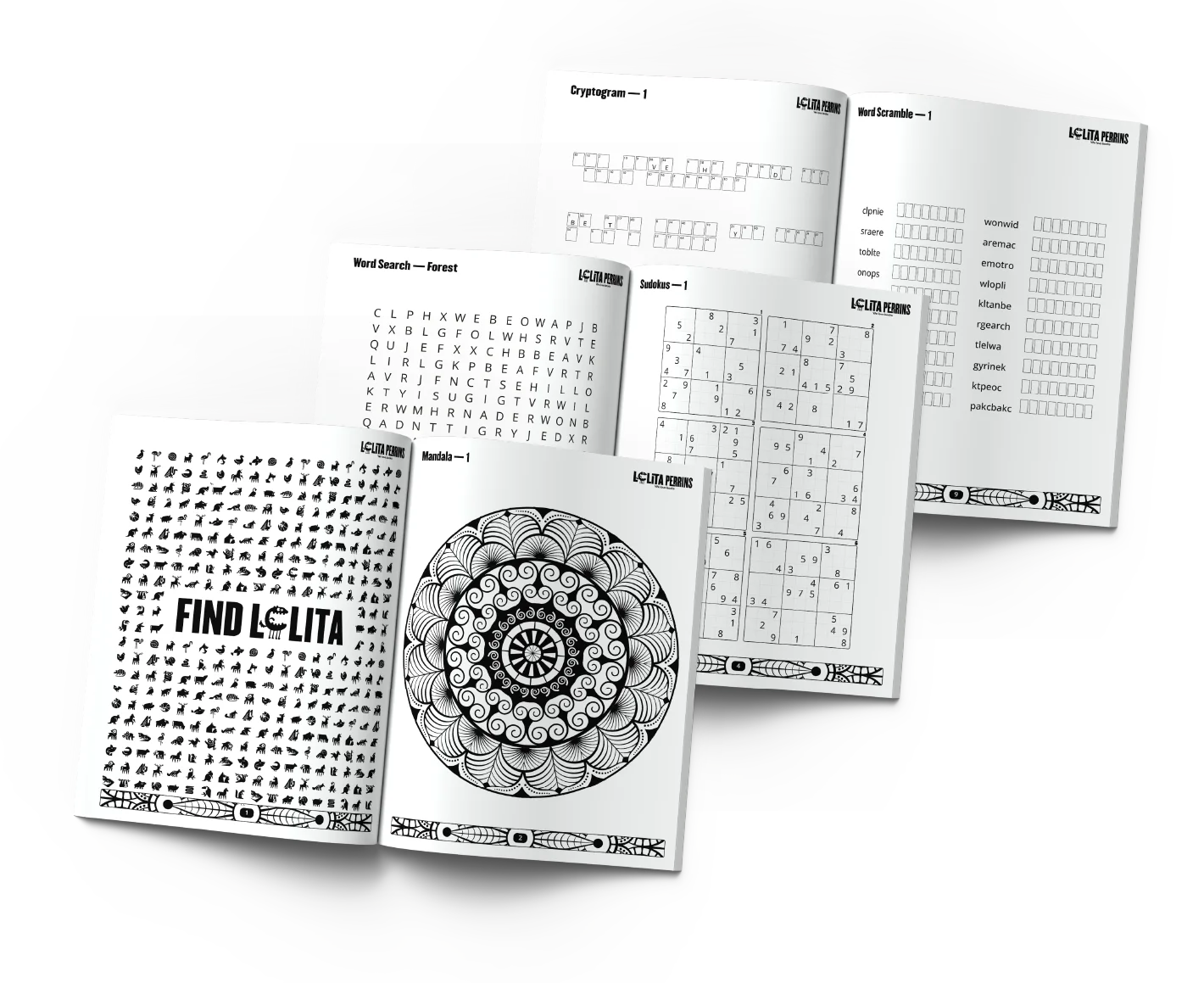
Would you like to talk to us?
If you have any questions, ideas, suggestions, or simply want to say hello, we’ll be happy to hear from you.
Fill out the form and we’ll get back to you as soon as possible.
We love hearing from you!
We look forward to your message with excitement and a big desire to chat about puzzles!